

-
Druid View
Druidism both is, and isn’t, a religion. It originated in a culture that didn’t originally have the Roman Catholic view of religion. It‘s perhaps more accurate to say it’s a wisdom tradition, sort of like a western Taoism. Shamanistic? Yes, in a sense, but not as strictly grounded as that. They had a long standing,…
-
Druid Paths
Sort of like Indian mysticism, the Druid recognized that spirituality isn’t a single path. They acknowledged three. The Druid as we know the word, who was the keeper of observances and the village Sage. The Ovate who was more like the Native American Shaman, seeker of spirits and signs, and psychopomp or spirit guide to…
-
Natural Magic
The Druids tended to live outside of tribal holdings, and not in the walled villages. Bards tended to live in them, but move from one village to another, and Ovates tended to live in places of power, but not natural power per se. Druids lived near their sacred groves. In border spots like caves, Ovates…
-
Druid Practice
Divination by Druids was to see the spiritual forces in the world, and it was often for healing. They didn’t see disease as a punishment from God that you should just take because you deserve it. They saw it as an imbalance. So any plague, or famine, or what not, was cause for divination, and…
-
Druid Creed
It’s hard to say much that’s absolute about Druid creed, because as part of their creed they were not absolutist thinkers. The culture the Druids would be most like is the Magi, and they would often later be called Magi in Latin records of them. They were rationalists, but not materialists. Before the advent of…
-
Return to the Garden
The Druids were not a dogmatic people, and it would be entirely reasonable if you see gnosis in nature, to adopt the Druid name. You would not dishonour the ancestors having no static doctrine and gaining wisdom from observances of nature, and keeping of human history. To declare yourself a Druid is merely to say…
-
Respect Death
Those into what can perhaps most broadly be called “necromantic” practices, are not at odds with Druid thinking. Mediumship, or communing with the dead, and giving the dead place and respect were quite acceptable. Mediumship would have been undertaken by the Ovates. In our modern technological age, not only do we not adequately respect life,…
-
Sage And Wise
Shall we discuss Bard magick? It might help to start with some background on the school of thought known today as wizardry. It had an older name, but I am awkward with ancient tongues so I will just stick with what we all know. The ancient Wizards were the sages and wise men and women…
-
Bard Order
Bards were perhaps the most feared and respected of the Druid order. The Druids themselves lived as hermits when they weren’t officiating ceremonies, even practicing asceticism much like a Buddhist monk. You could call a news anchor a Bard perhaps? Yes, you could. But the old Bards had more integrity and wielded their influence much…
-
History Of Bards
The Bards kept a history not only of their people, but of language itself, and song extending back into what we would call prehistoric time. Perhaps to no surprise, their history parallels what science now says of language development in the brain. They speak of a time when nothing knew what it was, so the…
-
Magic Song
How would a Bard cast a spell? They would compose a song. Having to have a clear form, they used specific rhythms, and they had rules about spoken as well as implied connections. Rhyme. The structure of a Bard song would rhyme the word describing an object with other words they meant to transform it…
-
Will In Song
You can even practice divination with Bardic magick. Ever notice when you are relaxed and maybe talking to yourself a little bit, you will sometimes say something you didn’t expect to say? And learn something from it? That’s Bard magick, just a bit sloppy, stifled. Singing makes you loosen your control of that. When you…
-
Acting to Preserve the Balance
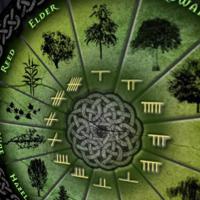
Much of the world’s oldest lore is difficult to fully comprehend in our era, difficult but not impossible. Tonight we are talking about the ogham script, the written form of the old Irish language. It is thought of as a “tree” script for two reasons. Many of its characters are named after trees, and the…
-
Relationship of Trees
Can you give us a bit of a chronological time-frame for ogham script? Neo-lithic? Ah, well the exact origin hasn’t been firmly established, but to date the presence of the ogham script has been traced as far back as two centuries BC. In fact, it’s commonly believed that a lot of the found examples of…
-
Culture of Story
This culture of the druids feels to me like Pantheism or maybe Animism? I believe the word is panentheism, pan•en•the•ism/ Noun: The belief or doctrine that God is greater than the universe and includes and interpenetrates it. In fact, the concept is similar to that described in old Judaism, poorly understood these days. In the Bible,…
Category: Druidism
Druidism is a wisdom tradition. If you see that nature is the source of wisdom, and that you can learn anything that you need to know from it, philosophically, spiritually, or scientifically, it is not unreasonable to call yourself a Druid.
Druids were both natural philosophers and theologians. They did engage in contemplations of God, but not in the modern sense. God in the metaphysical sense as a part of explaining why the world behaves as it does, and in drawing conclusions about how to handle human needs. They didn’t look to the Gods as distant sources of law. For them the Gods lived here in the invisible part of the world, and what you did or didn’t do for or against them would have an immediate or prompt consequence. Many scientists these days are seeming very Druid are they not? And their discoveries, as well as moral observations are backing up what the Druids already believed. That we have a positive wisdom in our very natures as living beings, and not to heed it is the most serious error.
Read more on Dark Druids in Dark Metaphysics.
Song of Amergin:
I am the wind on the sea
I am the wave of the sea
I am the bull of seven battles
I am the eagle on the rock
I am a flash from the sun
I am the most beautiful of plants
I am a strong wild boar
I am a salmon in the water
I am a lake in the plain
I am the word of knowledge
I am the head of the spear in battle
I am the God that puts fire in the head
Who spreads light in the gathering on the hills?
Who can tell the ages of the moon?
Who can tell the place where the sun rests?
~ Druid Amergin